The real Trojan horse
I saw the film last week, and as a film I enjoyed it a great deal, even though, for all the intricacy of its telling, what it has to say is fairly straightforward: a story about post-traumatic stress, about change, about the consequences of one’s actions and coming to terms with the past. In other words, it is what in Finnish is wryly called vanha mies muistelee, an old man looking back on his life. The scene that stayed with me comes near the end: Odysseus, disguised as a beggar, sits with his wife and tells her what he has lived through. It is extremely powerful. It is worth knowing what the same scene is in the poem: there the disguised Odysseus tells Penelope an invented tale of having once hosted her husband, she weeps at a story about the man telling it, and whether she already suspects him is a question scholars have argued for generations. The film offers a confession where the poem offers a riddle. That difference, it turns out, is what this whole post is about.
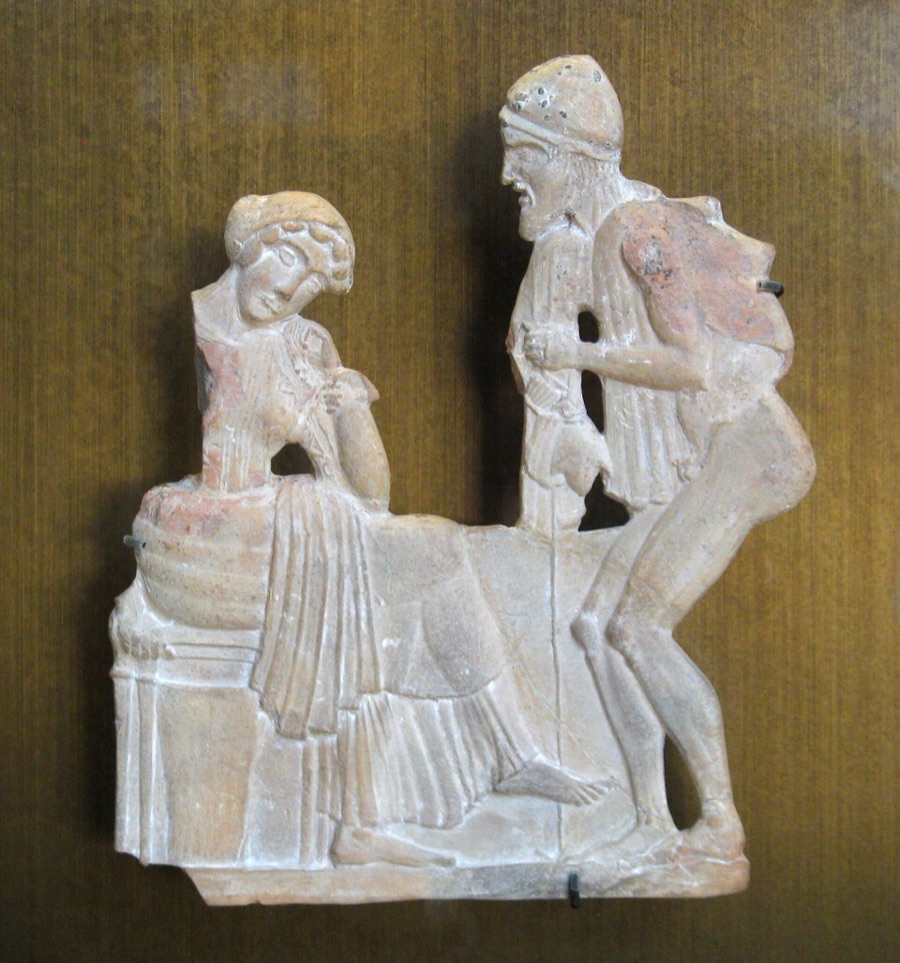 Penelope and the returning Odysseus on a Melian terracotta relief of about 450 BC, from Milos. Penelope sits with her head bowed on her hand while the traveller leans towards her in the felt cap and short cloak of a man off a ship, the two of them alone with a secret that the plaque, like the poem, declines to resolve. Louvre, CA 860. Photograph by Mark Landon, CC BY 4.0.
.jpg)
There are three things a film can do with each theme of the story beneath it. It can honour the theme, it can miss it, or it can turn it to its own purposes. The most revealing thing about the argument now surrounding Christopher Nolan’s The Odyssey is that its sharpest critics do not reach for the second option. The ones who do are the least convincing for exactly that reason, because the film is too accurate to be a misreading. Stelios Panagiotou, for one, calls it a “gross misunderstanding” of the epic’s philosophy. The film finds one of the poem’s two ethical centres, xenia, the sacred bond between host and guest, and builds everything on it; the other, nostos, the homecoming, it will spend the film dismantling. It knows the poem’s architecture, its singers, its recognition scenes. It does not stumble over Homer. On the themes that matter most, it performs the third option, and performs it deliberately. What makes the case interesting is that naming the turn does not settle the argument about it. The turn comes into focus only when the film is set beside the wider tradition of the epic rather than beside the Odyssey alone, and there the critics turn out to be right about where the film ends up and only half-right about how it gets there: what they call a modern imposition is, in its materials, older and more canonical than they think. Its age, though, does not neutralise what they are reacting to.
I do not normally write about anything other than mathematics; this blog exists mainly to explain my own research, and as such, this is an exercise for me. But the text below is written the way I write mathematics: state the claim precisely, check it against the sources, and say plainly which steps are established and which are interpretation. Several of the sharpest readings quoted here come from pseudonymous accounts in an online argument rather than from classicists. I have weighted them by the quality of the reading rather than the credential behind it, and where a claim is a matter of fact rather than interpretation, I have gone to the texts. Where I describe what happens on screen without a citation, the source is the film itself.
A beginning in Virgil’s shape
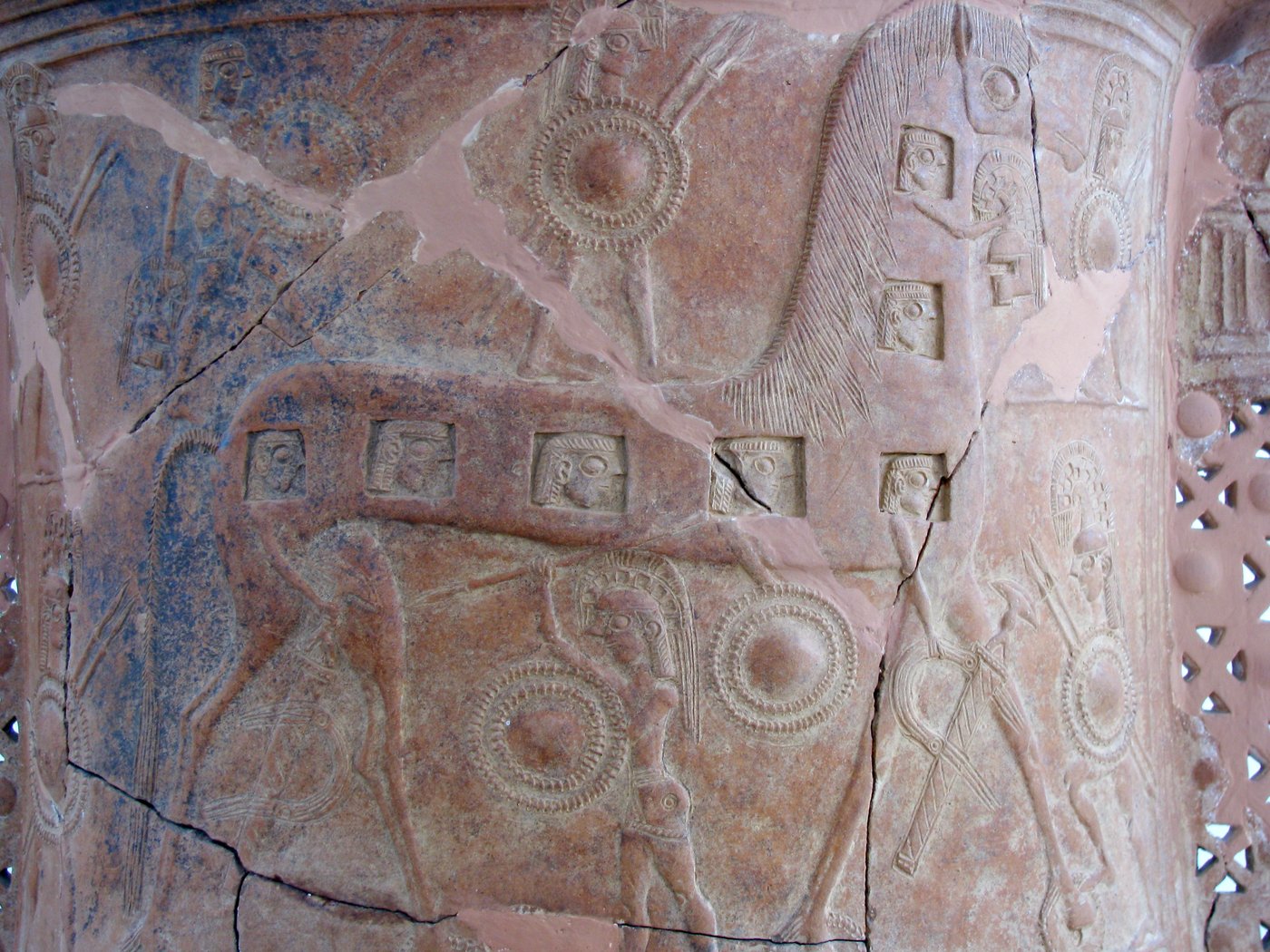 The Trojan Horse on the neck of a relief pithos from Mykonos, about 675 BC, one of the earliest objects to depict it: Greek warriors surround the Horse and more look out from the portholes in its flank, while the metopes below carry the sack of the city. Archaeological Museum of Mykonos, inv. 2240. Photograph by Travelling Runes, CC BY-SA 2.0.

Start with the mechanism, which Kyrios Mykonos sees most clearly. The film’s founding motif is the Trojan Horse as Odysseus’s original sin, an offering of peace that broke Zeus’s law of hospitality and set an entire civilisation on the road to collapse. But the full story of the Horse, and the character of Sinon, whom Nolan imports, is not Homer. Sinon appears in neither the Iliad nor the Odyssey. His fullest surviving portrait is Virgil’s, in the Aeneid, where the fall of Troy is told in full. In the Odyssey the Horse is mentioned only in passing. Its full account is Virgil’s, and in Virgil the Greeks are the aggressors and the Trojan is the victim.
From this follows the best single insight in the whole debate. When Nolan builds his film’s foundation on the Horse, he makes us watch the Greek forebears, for the length of the film, through Virgil’s eyes rather than Homer’s, not as conquerors rewarded for their cunning but as guilty parties, aggressors, breakers of a sacred trust, though Homer himself, as the Phaeacian court will show, once turned that gaze on his own hero. This, as Kyrios puts it, is the real Trojan horse of the movie. It is not a modernisation of Homer. It is a change of source.
That puts the philological complaints in a different light. Panagiotou is right that the film drops Odysseus’s meeting with the souls of his mother Anticleia and of Achilles, which is one of the poem’s most beautiful and serious scenes, and he sees the trade himself: the scene goes, he says, to make room for a story that was never in the poem. What the complaint does not draw out is where that story comes from. The nekyia loses Anticleia and Achilles to the invented Sinon, whose death Odysseus is made complicit in by concealing from him the Horse’s true purpose. Nor does Sinon merely arrive. He takes over the narrative role of Elpenor, the companion who dies unburied in Homer and whose ghost is the first to reach Odysseus among the dead, pleading for a grave. A Virgilian character now stands where a Homeric one stood, which is the whole switch performed in a single substitution. Nolan inverts him in the importing, since Virgil’s Sinon is a willing accomplice who survives and Nolan’s is a boy deceived by Odysseus who dies for it, but the name, the lie that carries the Horse through the gate, and the Trojan side of the story are all Virgil’s. The change is not carelessness. It is the switch, working at the level of structure.
An ending in Dante’s shape
The ending switches sources again. Nolan’s Odysseus abdicates the throne to Telemachus and sails west with Penelope into an unknown west as a self-imposed exile, penance for the blood on his hands and for breaking Zeus’s law. The film makes that ending structurally necessary rather than merely appended. Its suitors weaponise Zeus’s law, invoking the claim of the guest to consume Penelope’s household, so that killing them is not the law’s vindication but one more breach of it, and exile becomes the penalty Odysseus accepts for a violation he cannot avoid committing. In Homer the same slaughter is justice, earned precisely because the suitors abused hospitality, and Athena halts the reprisal so the king can keep his hall. The identical act is a restoration in one telling and a final sin in the other. Kyrios reads the result correctly as a turn inward, a man whose punishment comes not from the gods but from himself. Its nearest literary ancestor, though, is not the modern therapy culture the traditionalists reach for. It is Dante.
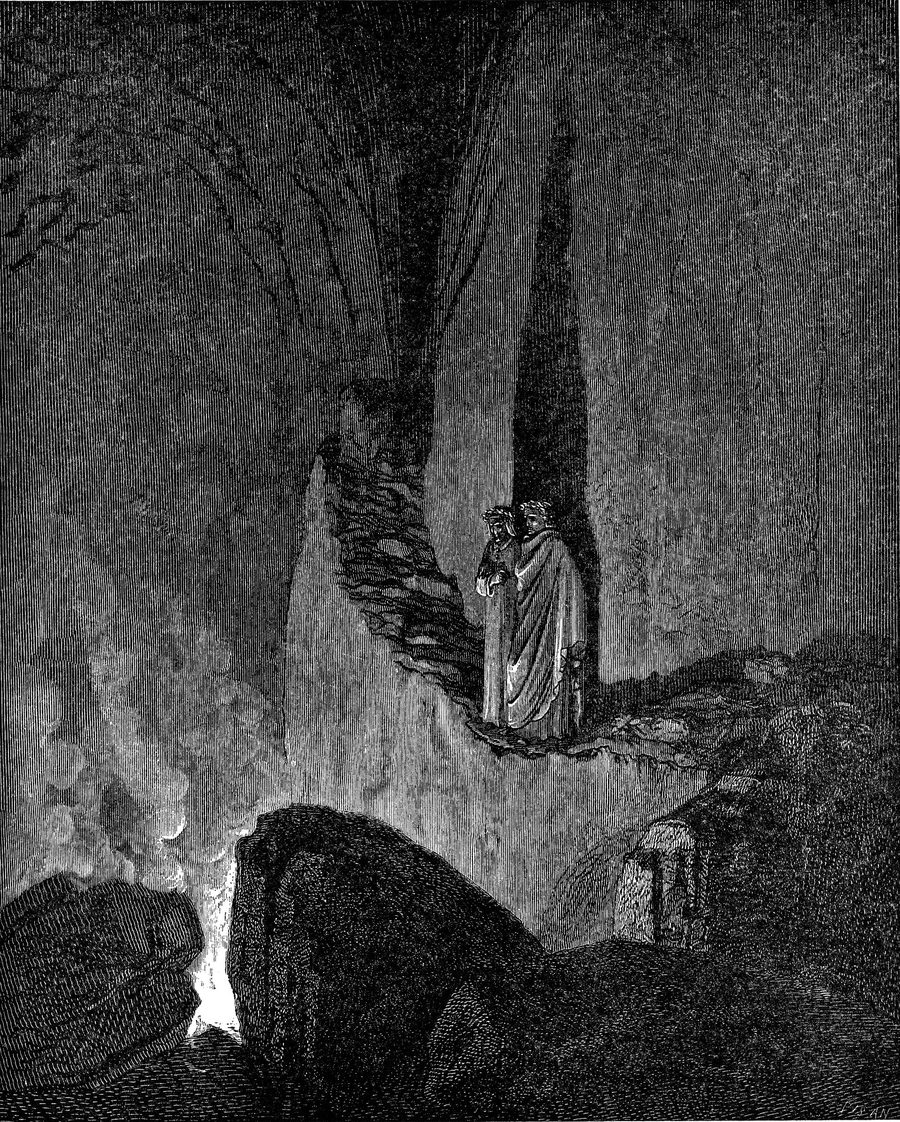 Gustave Doré (1832–1883), “The Flaming Spirits of the Evil Counsellors”, for canto XXVI of the Inferno. Dante and Virgil look down into the eighth ditch, where the counsellors of fraud are each hidden inside a flame. Ulysses burns there with Diomedes in a single twin-tipped flame, placed in that ditch for the Trojan Horse.
In canto XXVI of the Inferno, Ulysses is damned among the false counsellors, condemned in part for the deceit of the Horse. His last act is to sail past the Pillars of Hercules into the forbidden western ocean, following what he calls virtue and knowledge, until a whirlwind takes his ship. Nolan’s ending is that same shape without the drowning: guilt over the Horse, a westward voyage past the edge of the known world, a hero who leaves the world behind. Whether Nolan read the canto or reinvented it hardly matters; the shape he arrived at is the shape Dante built, and it is not Homer’s.
The two central claims of this post therefore rest on different footings, and I mark them accordingly: the Virgilian switch is demonstrable on the page, since Sinon is nowhere in Homer and his full story is Virgil’s, while the Dantean ending is a kinship of shape.
The guilt-structure itself, one transgression that lets ruin into the world, is closer to Milton, where a single forbidden act brings death into the world. That parallel is the tell, and the critics who sense a Christian lens over the film are right about it. The critic Titus Techera traces the specifics. The film reframes the Greeks as murderous pirates and the war itself as plunder, reasoning much as Augustine did in The City of God, that without justice a kingdom is only robbery on a grand scale. It also rewrites xenia itself, from Homer’s Zeus-enforced reciprocal duty into something close to the Golden Rule of Matthew’s Gospel, a universal and unconditional ethic. Techera even likens Nolan’s act of reinterpretation to St Paul telling the Athenians that the unknown god they already worshipped was Christ. Johnathan Bi reaches the Golden Rule from the opposite direction, reading the change not as a Christian inheritance but as the loss of the asymmetry on which xenia rests, since the Golden Rule presumes a moral symmetry that xenia never did.
What is wrong is dating that inheritance to the present. The pseudonymous Dvorstone, who makes the particularist case more carefully than most, calls the move an error “characteristic of philosophical liberalism”, which places it many centuries too late. Kyrios comes nearer, since he names the ancestry himself when he calls Nolan’s Odysseus a post-Augustinian man, and then files the result under “a secularized and digestible therapeutic Christianity”, as a modern product rather than an old inheritance still doing its work. This is a reading of Homer whose lineage is patristic before it is medieval, running from Augustine through Dante to Milton, and on into the modern. Yeats compressed the same logic into the fourteen lines of “Leda and the Swan”, in which a god’s violation of a girl leads without a pause to the walls of Troy in flames and Agamemnon murdered. It is part of the very West that the film’s particularist critics say they are defending, and Dvorstone’s version of that case rests not on who owns the stories but on their strangeness: the poem’s value, he writes, “lies precisely in its alienness”.
The premise underneath Nolan’s unconditional hospitality, though, is Homer’s own, and it is imported from nowhere: any stranger might be a god in disguise. In Book 17 a suitor rebukes Antinous for striking the beggar on exactly that ground, since the gods roam the cities disguised as strangers from afar, watching who keeps the law and who does not. What is modern in Nolan is not the premise but what he does with it, unhooking a reciprocal and ranked obligation and making it unconditional. Nor does the destination require Christianity. A Greek line running through Socrates’ refusal to return wrong for wrong, that one must never repay injustice with injustice or harm anyone whatever they have done, arrives near the same place, and Israelite tradition was reaching kindred formulations in the same broad era, forbidding vengeance and commanding that the stranger be loved as one born in the land. The convergence is old and multiple rather than a borrowing.
The Dantean parallel can be pushed too far, and pushing it too far is itself a way of taking Nolan’s side, so two qualifications are owed. Dante’s Ulysses sails out of hubris and forbidden curiosity, a trespass beyond mortal limits, not out of penance, and he never reaches Ithaca at all. His voyage is taken instead of the homecoming, against the claims of Penelope, Telemachus and Laertes, whereas Nolan’s Odysseus completes the return, is recognised, and only then leaves. Nolan’s guilt is secularised and historicised, tied to the Late Bronze Age collapse and the Sea Peoples rather than to sin against a divine order, and it is psychologised into something close to a veteran’s self-disqualification. The silhouette is medieval; what fills it is thoroughly modern, and that is worth conceding plainly, because it is part of what the film’s hostile viewers are responding to.
The other qualification is that the tradition of Dante and Milton is one deep line of Western reading, not the dominant one. The restorative Homer, the poet of nostos, of homecoming as the thing worth everything, is at least as central to how the West has read the poem, and it is the Homer that Herod Priovolos defends. To present the guilt tradition as the true Western inheritance would make the plain, homecoming Odyssey more marginal than it is.
The hero who sails west
Set those qualifications beside the film and a striking thing still remains. Nolan’s closing image, the wounded or displaced hero who sails over the water past the world’s edge and leaves behind only a story, is one of the deepest currents in the epic imagination, and not only the Western one. Aeneas flees a burning Troy westward to found a new city. Dante’s Ulysses and Tennyson’s Ulysses both sail west, and Tennyson drew openly on Homer and Dante at once. Arthur, mortally wounded, is carried by boat to Avalon as the once and future king, promised to return. And, the point that lands hardest for a Finnish reader, the Kalevala ends exactly here. When the lingonberry-born son of the virgin Marjatta is baptised king of Karelia and the old pagan world gives way, Väinämöinen, the great singer-sage whose weapon is the word, recognises that his age is over, sings himself a boat of copper and sails away between earth and sky, leaving his kantele and his songs to the people and promising to return if ever he is needed. A hero unfit for the new order departs over the water, leaving only song. It is Nolan’s Odysseus almost to the line.
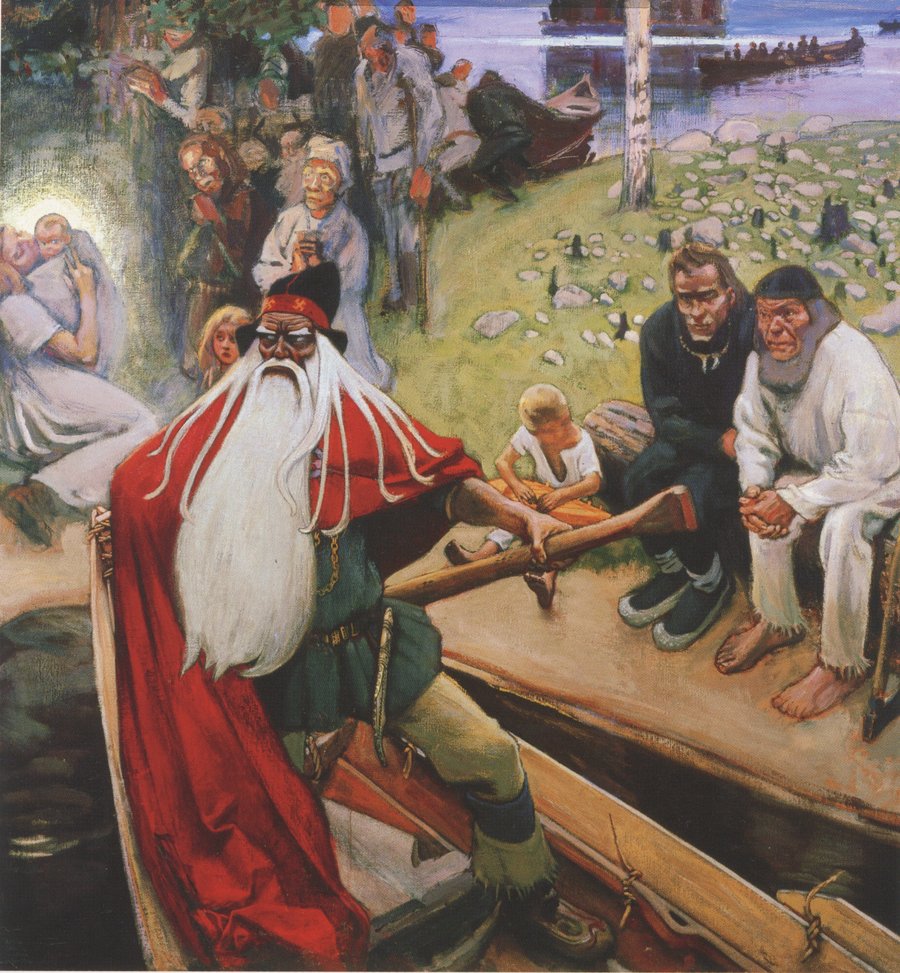 Akseli Gallen-Kallela (1865–1931), Väinämöisen lähtö, 1906, after the fiftieth and last rune of the Kalevala. Väinämöinen sits in his boat as the shore looks on; at the left are Marjatta and her miraculous son, and Gallen-Kallela painted the glow around the child to press the parallel with the Christ child. Hämeenlinna Art Museum.
Almost, and the gap matters. Väinämöinen yields to a higher, incoming order; his departure is the old making way for the new. Nolan’s Odysseus yields to no higher order at all. He punishes himself in a world where the hierarchical and divine order has already collapsed. As an elegiac image the parallel is exact; as a full analogy of motive it is not. The closer match for motive is Tolkien, himself a philologist, whose Frodo saves the Shire but cannot be healed in it, too deeply hurt by the Ring and its loss, and sails from the Grey Havens over the Sea. That is Nolan’s Odysseus precisely, the saviour for whom homecoming is no longer possible. So the three fit at different depths. Dante supplies the plot, guilt over the Horse and the westward voyage. The Kalevala supplies the image, the bard who leaves only his songs. Frodo supplies the motive, a wound that forecloses return.
Those last two are not independent witnesses. Tolkien read the Kalevala as a schoolboy, called the tale of Kullervo the germ of his own legendarium, and built Quenya on Finnish phonology; while immersed in the poem in 1914 he wrote a mariner’s voyage that scholars read as an echo of its closing scene. Both works end with a departure by ship to lands beyond the mortal world. The image and the motive belong to one family, which makes this less a motif that surfaced independently across cultures than a line that can be traced.
There is a consequence here that the film’s angriest critics miss, and a limit to that consequence that its defenders miss just as often. Grief-epic is older than Homer. In Gilgamesh, older still, the hero’s quest for immortality fails, and the poem ends by pointing at the walls of Uruk, because what survives a man is the work, the story. The wounded hero and the surviving song are not modern impositions on the ancient world. They predate the Odyssey. So it is wrong to treat Nolan’s ending as simply a product of 2026.
But it does not follow that the ending is neutral, or that its ancestry cancels its present meaning. Nolan has said that the film is about the idea that a society can function only through respect for the stranger, and that this truth has not changed in three thousand years. The second half of that claim, the universality, is precisely what the particularist case rejects, and the objection is worth stating. Nolan assembles a specific constellation, the Trojan Horse as a civilisational original sin that poisons the whole Greek world, a hero who disqualifies himself from his own throne, and the moral priority of the wronged stranger. In 2026 that constellation reads as continuous with a sensibility its hostile readers say they recognise: inherited guilt, the toxicity of a civilisation’s founding acts, the ethical centrality of the other. Kyrios puts it most sharply, calling the result “a parable of inherited guilt and permanent moral disqualification” made for a people who “inhabit a moral landscape of guilt-ridden offenses to the ‘other’”, while readers who welcome the film describe the same constellation and reach the opposite verdict.
One item in that constellation, the toxicity of a founding victory, is already familiar to a mass audience from Villeneuve’s Dune, where Paul Atreides’s triumph ignites a holy war that will kill billions and traps the victor inside his own victory, though the exile that completes the pattern belongs to Herbert’s Dune Messiah rather than to any film yet released, and Villeneuve’s third instalment is due in December. An old image can carry a current argument, and this one does. The materials are canonical and the selection is contemporary, and neither observation defeats the other.
The same legibility runs through the ending’s emotional shape, and here the nearest model is Nolan’s own. The Dark Knight Rises closes on a hero who takes the fall for a necessary deception, stages his own death, leaves the city to a successor, and rides off with a companion, which is to say Nolan had already filmed this ending once and is mythologising it again. Behind it stands an older popular form, the Western gunslinger who cleans up the town and then rides on because the violence that saved the community has stained him out of any place in it. Shane is the pure case, and Logan is its elegiac late descendant, the broken protector who dies guarding the child who carries the future and who quotes Shane over the grave to say there is no going back. That is the guilt-disqualification beat, Frodo’s slot again, in the vocabulary of the multiplex. Its familiarity is part of why Nolan’s ending feels earned to viewers who have never opened Dante or the Kalevala, and it is a reminder that the switch does popular work as much as literary work: the turn toward Virgil and Dante arrives wearing a costume the audience already trusts.
Why “fidelity” is the wrong charge
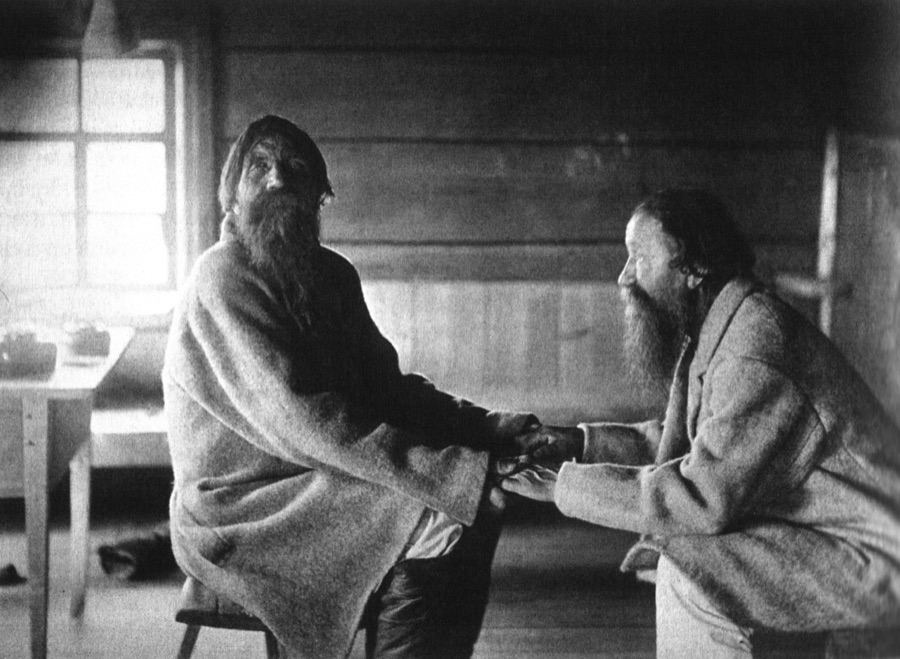 I. K. Inha (1865–1930), the brothers Poavila and Triihvo Jamanen singing runes at Uhtua in Viena Karelia, 1894. The two sit hand in hand, one leading a line and the other taking it up, which is the practice Lönnrot collected from and then edited into a single epic. The village is now named Kalevala, after the book made out of its songs.
This is where the Kalevala does a second kind of work, beyond the closing image it supplied earlier, and where the purist case starts to fray, though not in the way that would please a triumphant universalist, one who takes the poem to be common property that any age may remake. It is the complete answer to the purist premise in its strongest form, that a sacred original must not be altered, because the Kalevala is itself an alteration. Elias Lönnrot did not transcribe one poem. He assembled and edited a national epic out of the variant songs of many singers, shaping the arc and composing the bridges. The epic that defines Finnish identity is a nineteenth-century editorial construction laid over an oral tradition. That is exactly what the classicists say about Homer: Gregory Nagy notes there is no single original Odyssey in the modern sense, because the poem came out of oral performance, and Richard Martin goes further, saying Homer’s Odyssey was already historical fiction when it was composed, reimagining an ancient past of its own. There was never a fixed doctrine to betray. A careful purist can object that he never demanded fidelity to a lost original, only to the text we have, which has been stable since the Alexandrian editors. Fair, but the objection concedes the point that matters: what he defends is itself one edition of a plural tradition, a fixing rather than the fixed. Ali Arikan puts the consequence better: the poem “has no purists, only tellers”, and “each retelling is really a confession”. He continues with examples: “Virgil confessed empire’s need to launder its origins; Dante his terror of knowledge without limits; Joyce his faith that a decent cuckold walking home is epic enough; Tennyson his grief”. The question worth asking of any version is therefore not whether this is Odysseus, but who is holding the mirror.
So Dvorstone’s elegant formula, that universalising the poem is a reverse alchemy turning gold into lead, proves too much if it is taken as an absolute prohibition. Joyce universalised the Odyssey about as radically as anyone could, and Ulysses is a summit of the canon. The Kalevala itself universalised scattered charms into a nation’s myth. The fact of remaking is not the crime. But conceding this does not turn the particularist worry into a simple error, and it would be too convenient to let it. Dvorstone is not really objecting to remaking as such. He is objecting to a particular direction of remaking, one that files down the strangeness that gives the poem its power, and that objection survives the point about oral tradition intact. What the Kalevala refutes is the claim that any alteration is desecration. It leaves standing the sharper claim, that this alteration trades away something the older text was uniquely good at. Admitting the first does not require dismissing the second, and the philology of Panagiotou and Kyrios is precise, which is its strength. The right move is to put the charge on the correct axis, not to wave it away.
The real loss: polyphony
What is actually lost, once the false charges are cleared away, is neither fidelity nor some imagined purity. It is polyphony. Homer’s genius is his refusal of a single verdict. Kyrios reads this beautifully himself. The Cyclops episode poses a question, what does hospitality owe a host who has already broken it, and declines to answer. On his reading the sin there is not the blinding but the boast afterward, the reach for kleos past a limit, though Homer dates Poseidon’s wrath from the blinding and lets the boast supply the name that makes the curse addressable. The poem does not end in a peace anyone has earned: the avengers come, the fathers of the suitors are met in the field, and Athena and Zeus stop the fighting and impose an oath of peace and forgetting. Restoration in Homer is bloody, partial, and closed from outside. Nolan collapses that irreducible ambiguity into one clean thesis in the shape of guilt: one transgression, a civilisation poisoned, a man sentenced by himself. Not every viewer sees the collapse, and the ablest denial is Matt Zoller Seitz’s, who praises the film for giving us no “study guide summaries of what it all means” and presenting Odysseus’s choices, “laudable and horrible, just as things that happened”, for hero and viewer to grapple with. The difference is one of delivery: what the film declines to spell out in dialogue, its ending pronounces in the plot.
The scene I began with is the purest case. Homer’s Penelope listens to a beautiful lie and may or may not see through it; the poem never says. Nolan’s Penelope receives a confession. Between those two scenes lies everything this post is trying to describe. Emily Wilson told the Sunday Times that the film did not land emotionally for her at all, and that it gave her no reason to care whether the man got home. I was moved and she was not, and the likeliest reason is that she was measuring the scene against what the poem does with it. It is, as Kyrios notes, precisely his method elsewhere, a simple moral in baroque wrapping, the same move that reduces Interstellar, Inception, and Oppenheimer to a single legible message.
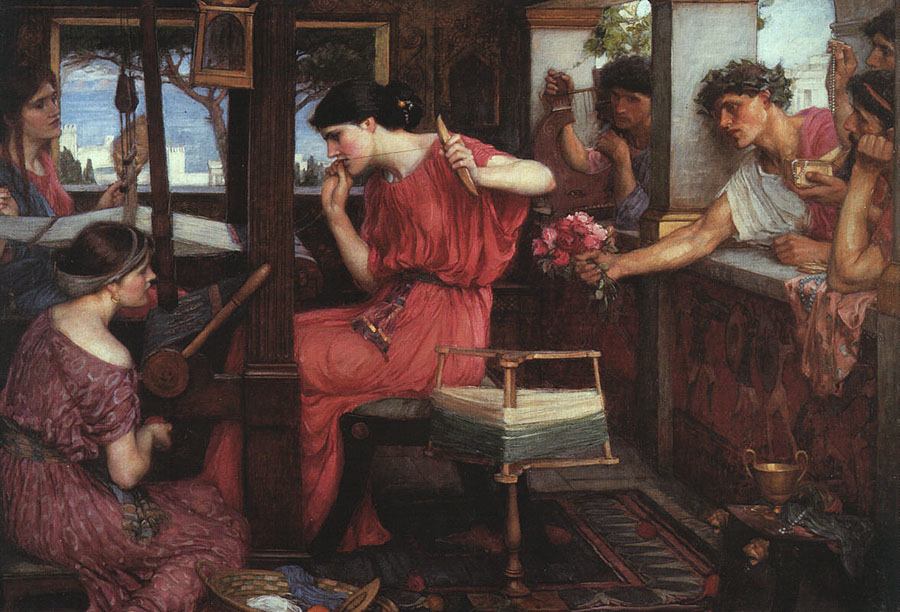 John William Waterhouse (1849–1917), Penelope and the Suitors, 1912. Penelope works at the shroud for Odysseus’s father Laertes, which she has promised to finish before she takes a new husband and secretly unravels again each night; she cuts a thread with her teeth while two maids work beside her and the suitors press their gifts at the window. Aberdeen Art Gallery & Museums.
Two streams were available here, and the choice between them is not neutral. This is the strongest form of the objection. Homer’s openness and the restorative nostos tradition are not simply one option among interchangeable equals. They are the harder ones to film, because they ask a viewer to sit with a verdict that never arrives. Choosing the guilt stream instead does something specific, and translation has a word for it: it domesticates, in the sense Wilson uses when she describes the pull in every translation between “I’m going to familiarize it” and “bringing something alien into our culture and making us able to respond to it”. It resolves the poem’s tensions in the direction of a sensibility the audience already holds, and it quietly retires the confrontation with a world that measured worth by cunning, honour, and vengeance rather than by guilt and empathy. That is the loss Dvorstone gestures at, and it is not a phantom conjured by nostalgia.
Underneath the moral exchange lies an aesthetic one. The Homeric world holds that the quasi-divine beauty and excellence of a Helen or an Achilles can dignify the carnage they set in motion, so that the blood spilled on the plain at Troy reads as the founding sacrifice of a civilisation rather than as a crime. Nietzsche made that premise explicit in The Birth of Tragedy, whose most repeated formula is that the world stands justified only as an aesthetic phenomenon, and whose tragic spirit affirms suffering rather than seeking redemption from it. He was candid about the opponent, treating Christianity throughout with a pointed silence. The Christian premise refuses the trade, since suffering is redeemed by innocence and atonement and never by beauty. Nolan does not simply reverse Homer’s verdict on his hero. He declines the older claim that excellence can justify what it costs, and the film’s tone follows it down, brutal where the poem is noble.
Here the three factual errors Panagiotou catalogues stop looking like errors and start looking like tools. Zeus does not hate Odysseus; Athena defends him in the poem’s opening, and it is Poseidon who is wrathful, over the blinding of Polyphemus. Odysseus never ate the lotus; his men did, on a different island. Most tellingly, Calypso did not want him gone: she offered to make him immortal and ageless if he would stay, and he chose a mortal home anyway, a choice that is one of the poem’s philosophical pillars and one the film simply deletes. Each of these serves the same thesis. The unglamorous explanation deserves its hearing first. Three hours, a studio, many hands on a script: long static scenes are exactly what gets trimmed, and any one of these changes could be an accident of compression. What resists that reading is their direction. Accidents scatter; these all point the same way, and replacing Anticleia and Achilles in the underworld with an invented Virgilian is a trade rather than a trim. That is the signature of a thesis, not a slip.
The same logic reaches down into the machinery of the plot. In Homer the disguise works only because Athena transforms him, withering his skin and dimming his eyes so that not even his household knows him. Nolan will not allow the miracle, and as Arikan notes, he blinds Eumaeus instead, re-rigging the mechanism so the story can run without gods. It is the whole argument in one plot fix. Where the poem needs a goddess, the film needs only an infirmity, and the divine order that Homer’s world runs on becomes scenery that the story no longer requires.
It also forces a correction to the instinct I began with, that the film is too accurate to be a misreading. It is flattering to call the film a conversation with Homer conducted in Homer’s own material. It is not, quite. The accuracy in certain places (xenia, the recognition, the singers) does not make the whole a sophisticated reinterpretation so much as a more effective vehicle for Nolan’s recurring obsession. Many of the changes are not delicate commentary. They are dramaturgical simplifications pulling in one direction. The betrayal, if there is one, is not of Homer’s values but of his method, many voices exchanged for one readable message.
The same verdict from other directions
A reader need not care about Homer’s method to find the film narrow. Joel Christensen, who says everybody knows he was the worst audience in the room for this film, calls it, of all things, conservative, and means the constraint on the women’s roles. Bret Devereaux, a historian of antiquity who takes the film as a pointed intervention in the arguments of the present, ends up describing its moral architecture as almost Burkean: catastrophe follows not from a society’s structural injustices but from the violation of inherited norms. The two are not saying one thing, since the first is about who is allowed to act on screen and the second about a theory of collapse. But a film read for its politics from opposite ends comes back conservative both times, and that is likelier to be about the film than about either reader.
The last word on narrowness belongs to the film’s own source. Wilson, whose translation reportedly informed the screenplay and whose celebrated first line renders polytropos, the man of many turns, as “complicated man,” finds the result neither complicated nor about a complicated man. What Matt Damon plays, in her description, is “an action hero who feels bad about being an action hero.” She has since made the case at length, in a review for the London Review of Books titled “An Uncomplicated Man”, which states the whole argument in three words. Her central charge there is that the film has nothing convincing to say about time, memory, history or war, nor about the relation between one warrior’s glorious return and the lives of his family, his adversaries, his comrades, his friends and his neighbours. That complaint is the polyphony argument in her own terms: a hero’s return means something only when the poem keeps counting what it cost everyone else. The same flattening reaches the hero himself. The scheming has been stripped out along with the comedy: no Cyclops name-trick, no delight in disguise, not even a scene of the Horse being built. The film’s tech hero agonises at length over what his invention did and is never once shown inventing. The man the poem names for his turns has had the turns removed.
My chief witness is not disinterested. Her verdict has hardened since that first interview into a polemic that includes the line “I would be ashamed to have written any part of this script”, and it is written by someone whose translation was used in the publicity and whose reading of the poem she considers betrayed. That bears on the weight of her verdicts, though not on her observations, which are checkable against the film.
In that review she also calls the film’s narrative structure gimmicky, and there we part company, though less sharply than the word suggests. She grants in the same piece that Nolan’s jumps and twists are “appropriate for The Odyssey, a narrative of tales nested in tales”, although the paragraph holding that concession ends by likening the film to “an elaborate Fourth of July fireworks display” with “about the same level of narrative and emotional depth”. In the earlier interview she was warmer still, saying she loved the braided narrative. What she denies is that the device pays for itself: it is, she said there, “this quite small-scale clever gimmick about narrative, but then it’s blown up to an enormous IMAX scale”. The quarrel is about proportion, not about the frame.
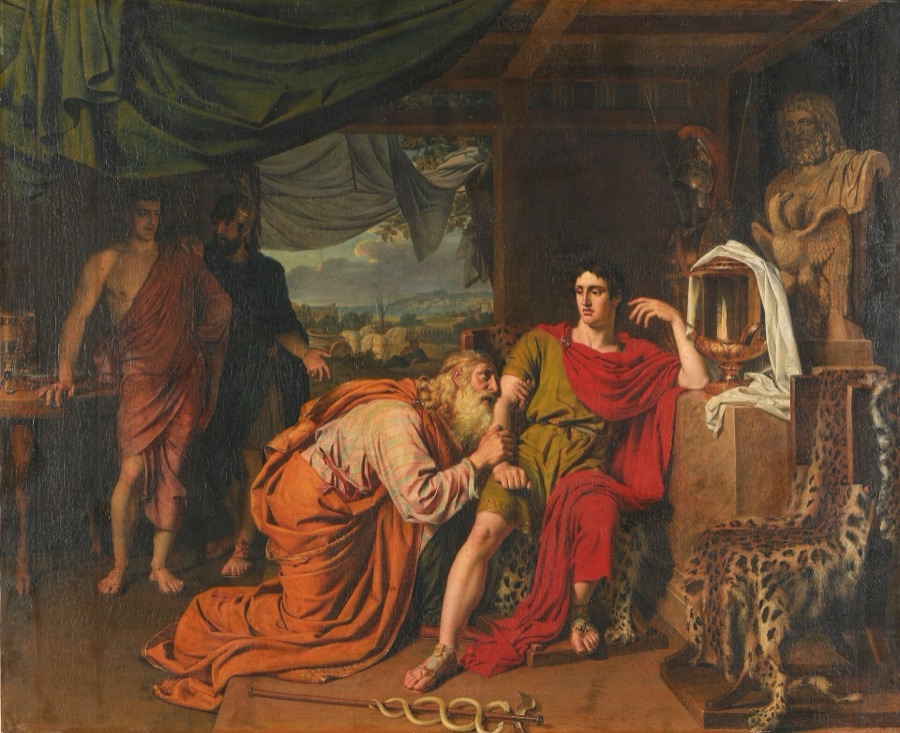 Alexander Ivanov (1806–1858), Priam Asking Achilles for the Body of Hector, 1824. Priam has come by night to the tent of his son’s killer and kisses the hand that killed him, and a herald’s staff lies on the floor between them. The Iliad ends not on the Greek triumph but on Hector’s funeral, the enemy mourned at full length. Tretyakov Gallery, Moscow.
She catches a paradox, too, that cuts deeper than any philological complaint. A film organised around guilt toward the victims never lets the victims be people. Wilson writes that the film’s Trojans “are dehumanised by their masks” and that “we know none of them by name or face”. The effect she names is not confined to the Trojans. Devereaux calls Agamemnon “an almost entirely faceless, frequently voiceless force of destruction”, and David Ehrlich describes the same figure wearing “an enormous suit of black armor as if he were piloting a mech”; Agamemnon leads the Greeks. What the film withholds is not the enemy’s humanity in particular but almost anyone’s: nearly everyone who is not Odysseus is reduced to a function. There is a defence available here, and it is the best one the film has; I take it up below. Set against that withholding, the poem the film corrects is the more humane document. Homer gives the Cyclops a favourite ram, spoken to with tenderness by the blinded monster, and the Iliad does not end on Greek triumph at all but on Hector’s funeral, the enemy mourned at full length. The epic that supposedly glorifies the victors keeps insisting that the defeated are human. The film that indicts the victors forgets it. And if the poem can both dignify the carnage and weep for it, both Nietzsche’s Homer and Wilson’s, that is no inconsistency here; it is the polyphony this post is about.
What Nolan gets right
Fairness requires the other column, or the post tips into the one-sidedness it is diagnosing. The Odyssey is among the most self-conscious works in literature about storytelling itself. It is full of singers, and its hero is a professional narrator of his own life. Nolan puts this at the centre. Seitz opens his review on the point: the film begins with a bard standing on a table in a banquet hall, telling a story, and the tale he tells the suitors is the fall of Troy, as if the Iliad had broken out inside the Odyssey. That is exactly the right frame for a film about how stories deceive and liberate us. Much of the picture is likewise a tale Odysseus is telling about himself. The frame also closes as it opened. The film ends with Odysseus telling Penelope that later generations will need bards, because they will no longer be able to write, and the history behind the line is real: Greek writing was lost in the collapse and returned four centuries later on an alphabet borrowed from Phoenician. Nolan’s last note therefore depicts the birth of the condition that produced Homer. The oral tradition whose openness no single author ever had to resolve begins where the film leaves off, which is, by accident or design, its shrewdest gesture.
Here Travis Scott’s bard, the Ithacan Phemius, is not desecration but insight: the oral epic singer and the improvising rapper are both keepers of memory and reputation, and the analogy is defensible even where it stings. It is also Nolan’s own: he told Time that he cast Scott “because I wanted to nod towards the idea that this story has been handed down as oral poetry”. The film half-keeps the promise. Spencer McDaniel, an ancient historian, notes that the staff itself is genuine, since Greek bards tapped one on the ground to keep the rhythm while composing hexameter, and that Nolan misses both halves of the practice: his bard pounds where the historical one tapped, and “is not speaking in hexameter verse. In fact, he’s not even speaking sentences; he’s just saying evocative words.” The bard returns near the end to intone the first line of Wilson’s own translation, invoking the Muse and her complicated man, and he sings over the closing credits; between those two moments the film asks him for very little. Whatever else it does, the film sends people back to the poem, and Monica Cyrino, a classicist who chairs her department, expects fuller Greek classes. That is not nothing.
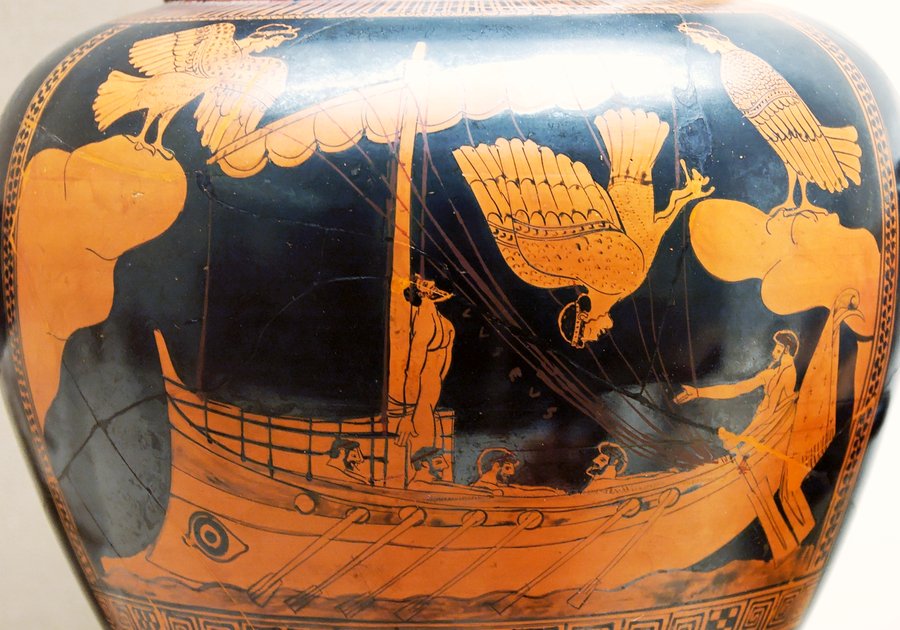 Odysseus and the Sirens on an Attic red-figure stamnos of about 480–470 BC, the name vase of the Siren Painter, found at Vulci. On Circe’s advice Odysseus has stopped his crew’s ears with wax and had himself bound to the mast so that he alone may hear the song, and one of the Sirens, foiled, casts herself headlong into the sea. British Museum, E440. Photograph by Jastrow, released into the public domain.

Notice, too, where the real disagreement lies. Herod Priovolos, in the most humane of the posts, reads the monsters as Nolan does: the Cyclops as power without justice, the Sirens as the temptation to abandon one’s purpose, Circe as the loss of one’s humanity, Calypso as immortality turned prison. He insists as well that Ithaca is not an island but the place that remembers you when the world no longer knows your face. He and Nolan share the allegorical method. What Herod demands is only that the arc end in recognition and return, Penelope and the olive-tree bed, rather than in renunciation. The quarrel is not about method. It is about the verdict that homecoming is finally allowed to reach.
Whose account is this?
The film opens on a man telling a story, and it is worth asking whose account we are watching for the three hours that follow. Arikan states the frame plainly: on Calypso’s island a “lotus-drugged Odysseus” tells “the story as it comes back to him in pieces”, the sequence “pulling double duty as the Phaeacian court”. McDaniel gives a section of her breakdown to the same structure, noting that the film keeps the poem’s “non-linear narrative structure and use of Odysseus as an unreliable narrator”, and that Nolan’s hero tells it to Calypso in pieces, “while he is recovering his memory”. Techera, who likes the film a great deal less, reaches the same description more bluntly: Odysseus “is just talking to himself”. Wilson notices that “the theme of amnesia takes on new significance”. The wanderings, on this account, are not narrated. They are recovered. This is a third kind of claim, weaker than the two marked earlier: the Virgilian switch is demonstrable and the Dantean ending is a kinship of shape, while this is a reading the film licenses in one strand and refuses in the other.
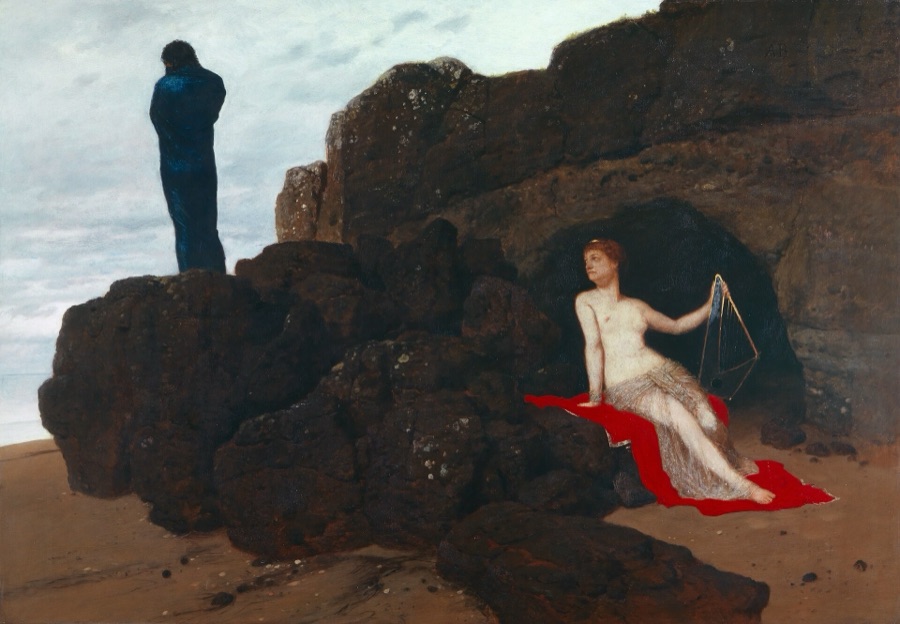 Arnold Böcklin (1827–1901), Odysseus and Calypso, 1882. Odysseus stands at the edge of the rock with his back to the island and his face to the open sea, while Calypso sits at the mouth of her cave with her lyre and watches him. Seven years of the poem pass on this shore, and the film makes it the place where the story is recovered. Kunstmuseum Basel.
Read that way, something the film is blamed for turns into a description of its method, and the test for what qualifies is the one already applied to Panagiotou’s three errors: where a plainer cause is on the record, the plainer cause wins. One instance survives it. Ehrlich objects that the attack on Troy “conveys little of the trauma described by Odysseus’ voiceover, and leaves us to take his word for it”, and calls this “a bizarre failing in a film that otherwise creates such a remarkably visceral sense of time and place”. Anomalous, that is, by the film’s own standard, and with no rival explanation offered. Wilson finds the same seam from the other side, objecting that during the sack of Troy, “which he supposedly organised”, Odysseus “gazes around in bewilderment and horror, as if he has never seen a massacre before”; the clause “which he supposedly organised” concedes the incoherence inside her own complaint. Both are describing a massacre remembered rather than a massacre commanded. Smaller signs cluster around it. Circe is foreshortened until Wilson can reduce the episode to a man who “kindly retrieves” his men, “without pausing to have sex with the goddess even for an hour, let alone a whole magical year”, and Calypso becomes “an unpaid therapist” listening to a “disjointed tale of woe”. The reading also answers the charge left open earlier, that everyone who is not Odysseus is reduced to a function: inside a reconstruction, they are.
The reading has a boundary, and the boundary is where it stops being a defence. Take the temptation first, because it is instructive. The Horse is never shown being built, and Wilson says it “appears on the windswept beach as if dumped there by drone”, which is exactly how an object arrives in memory, already there, its making gone. But she lists it third, after the marriage bed and the raft that carries him off Calypso’s island, and neither of those sits inside anyone’s recollection; her own explanation covers all three, that Damon’s Odysseus “seems to lack technological intelligence”. Accidents scatter, and this habit points at the director rather than at the narrator. The harder boundary is structural. A film assembled from one man’s recollection cannot show what he never saw, and this one opens by doing exactly that, since the Trojans discover the Horse and kill Sinon while Odysseus is sealed inside it. Ithaca then runs in parallel for twenty years he is absent from, Penelope’s resentment at being pressed to remarry is given as fact rather than as anything reaching him, and the Telemachy is a second strand with its own journey to Sparta. The subjective apparatus is granted to one character only: Odysseus gets the amnesia, the drugs and the unreliable narration, while Penelope, who owns the most famous dream in the poem, is given none in the film.
Nor is the film short of tellers. The fall of Troy arrives twice, once as Odysseus recovers it on Calypso’s island and once as Menelaus recounts it to Telemachus over dinner, and the picture opens on a third teller, the bard in the hall. It is formally polyphonic. That is what makes the verdict so striking: Homer’s many voices disagree, and Nolan’s all testify to the same thing. What the film gives up is not the number of speakers but the possibility that any of them is wrong.
Whatever its limits as a defence, the reconstruction is going somewhere, and where it goes is the scene this post began with. What Odysseus tells Calypso in pieces, while he is still recovering it, he finally tells whole to his wife, from behind a beggar’s face. Homer stages that same interview and fills it with a beautiful lie. Nolan fills it with the truth, and the man who has at last remembered everything then sentences himself for it. One man’s account of his own past is not offered here as an account. It is offered as what happened.
Could it have been otherwise?
The strongest case for the switch is not that Homer sanctions it but that a film cannot do what the poem does. The Odyssey’s openness is partly a property of its making. A work with no single author, assembled across generations of performance, can hold contradictory verdicts because nobody ever had to choose between them. A single feature with one runtime and one dramatic arc has to choose, and the choosing may be a cost of the form rather than evidence of a flattened sensibility. On that reading, what I have called domestication is simply what adaptation into drama looks like, and the fair comparison is not Homer but other films. There is a Homeric case for the anti-war reading too. The poem does count what Troy cost, in the dead companions, the twenty lost years, and the ghosts of Book 11, and a film that makes that reckoning its spine is developing something the poem already contains rather than importing it wholesale.
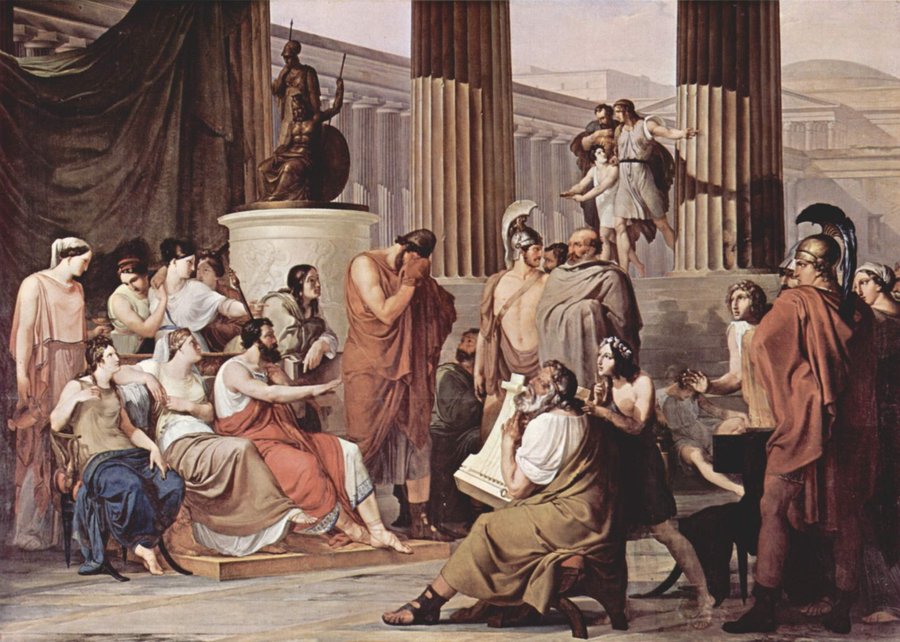 Francesco Hayez (1791–1882), Ulysses at the court of Alcinous, 1814–1815. Odysseus weeps at the Phaeacian court, his face covered, as the blind minstrel Demodocus sings of him and Achilles at Troy. That is the first of the bard’s three songs in Book 8; the wooden horse comes in the third. National Museum of Capodimonte, Naples.
The poem even contains, in miniature, the film’s whole point of view. In Book 8, at the Phaeacian court, Odysseus asks the bard to sing of the wooden horse, his own greatest triumph, and then weeps at it, and Homer reaches for an extraordinary simile: he cries like a woman flinging herself on her husband’s body as her city falls, feeling the spears at her back as she is led into slavery. For the length of one comparison, Homer gives his victor the eyes of his victims. A defender of the film can fairly say that Nolan has not imported Virgil at all; he has taken a famous and devastating simile of Homer’s and made a whole film inside it. The answer is this post’s whole argument in one sentence. Homer gives the victim’s eyes for the length of a simile, inside a poem that still gives Odysseus his hall; Nolan makes the simile the verdict of the entire film. A voice became the thesis.
The claim that the form forced the choice has an answer, though, and Wilson supplies it. It is not kind. Asked directly whether Homer’s Odysseus is simply unfilmable, given a blockbuster audience’s low tolerance for ambiguity, she refused the premise. The past quarter century of screen culture has run on ambiguous men, con artists and gangster patriarchs whom audiences follow gladly, and the proof sits inside this very cast: Damon himself played the talented Mr. Ripley back in 1999, lying his way across the sea, which is to say the production demonstrably had an actor who can do cunning, hired him, and declined the performance. In Wilson’s judgment Nolan reached for an easy idealisation when a notch more complexity was available and the viewer could have been trusted with it. If she is right, the flattening was not the price of adaptation. It was the purchase. Her examples cut with less force than she implies, since sixty hours of television can afford an ambiguity that a three-hour epic compressing twenty-four books may not. But Ripley survives the objection: two hours, one film, the same actor.
Not politics but an auteur’s subject
 Berlyn Brixner for Los Alamos, the Trinity test photographed 0.016 seconds after detonation, 16 July 1945. The fireball is roughly two hundred metres across and has not yet lifted from the ground. Arikan reads the film as the second panel of a diptych with Oppenheimer, the Horse treated exactly as the bomb was.
The reason Nolan wanted the switch does not run through the politics of 2026 at all, though several readers put it there, and in opposite places. Devereaux takes the repeated invocations of Zeus’s law to be aimed at “the Trump administration’s shockingly inhospitable attitude toward immigrants and foreigners”; Wilson takes the invented Sinon subplot to carry a didactic point about “the lies and xenophobia of the war on terror and Brexit”; Kyrios sees Nolan doing “exactly what the contemporary liberal order has been doing for the last quarter century”; Techera says that by the time Penelope complains about who is entitled to rule, “you feel like you’re back in 2026 America”.
The simpler explanation needs none of those readings. Nolan had made the film already. Arikan reads The Odyssey as the second panel of a diptych with Oppenheimer: the Horse treated exactly as the bomb was, a device that succeeded past its inventor’s intention, leaving him to live inside what he built and watch his ingenuity become everybody’s weapon. The film closes the loop by staging the killing of the suitors as a sack repeated indoors, the same deceit and the same slaughter, so that the method’s author meets it again under his own roof. On that account the switch is not an imported ideology but an auteur’s subject, the same story told twice, about “the man who wins the war and loses the account of himself”. This is the same habit that the polyphony argument counted against him, one legible message inside elaborate machinery, seen now from the other side, where it looks like fidelity to a lifelong subject.
What the Horse cannot carry
The strongest objection to the film is formal rather than political, and Arikan makes it. The bomb was a genuine discontinuity, with arithmetic and body counts behind it, so, as he puts it, “the guilt was in the archive before it was in the screenplay”. The Horse has no such standing and must be raised to it, a stratagem reclassified as a sin by directorial fiat, and that reclassification has Roman precedent, since Virgil made it first, on behalf of Troy’s heirs rather than its sackers. Kyrios makes the same objection from the philological side: the Horse is an act of wartime deception and not, on its face, a counterfeit of hospitality, so that reading it as a breach of Zeus’s law is already an interpretation rather than a datum. A film working in symbols could have borne the reclassification, since a symbol will carry any weight placed on it. But Nolan’s Odyssey is the most physical ever filmed, real water and real rivets, and his Poseidon has dwindled into a word men reach for when the sea turns against them. Literalism, in Arikan’s phrase, is a contract: it buys immediacy and it costs allegory. Three hours of sweat and timber cannot then ask their centrepiece to be a metaphysical event. The objection is worth keeping distinct from the question of whose account we are watching, though, since a scene shot with real water and real rope is still a recollection if that is what the edit makes of it. What Arikan is denying is that a stratagem can be raised to a civilisational sin by fiat, and that denial survives whoever is doing the remembering.
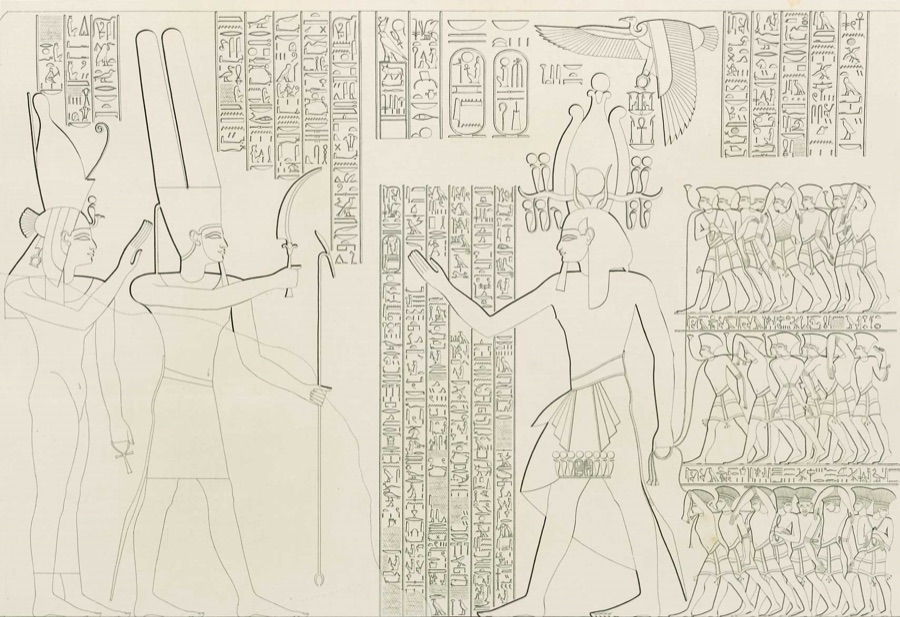 Karl Richard Lepsius (1810–1884), the first court of the mortuary temple of Ramesses III at Medinet Habu, drawn for Denkmäler aus Aegypten und Aethiopien, 1849. The king presents bound captives to Amun, each group marked out by its own headdress. These walls carry the fullest Egyptian record of the Sea Peoples and of the collapse the film dates itself to.
There is a historical objection too, and it is harder to answer than the philological ones. Cities burned and altars were fouled for centuries before the first soldier was hidden inside a wooden animal, and Arikan runs the litany of every age holding the same funeral for valour: the Church over the crossbow, the story told of the samurai and the musket, an Anatolian folk lament that valour left the world when the rifle entered it. A fall that recurs at every upgrade in weaponry is a strange sort of fall.
The literalism contract breaks at the level of history. Nolan grounds his collapse in the real Late Bronze Age, the Sea Peoples named and the ruin dated, but historians of that collapse describe a system failing on many fronts at once: climatic shifts destabilising centralised palace economies, the weakest states on the periphery going first, trade flows breaking, and the resulting waves of refugees and raiders bringing down the rest in a domino. Nolan’s cause is single, and it is moral. The reduction is the same one the film performs on the poem, now applied to the history.
The casting argument
The loudest public argument about the film has been about its casting. It is a different argument from the one made here, and I mean to set it out rather than adjudicate it, because nothing in the switch of sources turns on it: Sinon stands in the underworld whoever plays him, and the ship sails west whoever is aboard. Claire Lehmann put the shortest form of one side, that a film with a one-eyed monster who eats men like sweets and a witch who turns men into pigs was not offering realism to begin with. The film’s departures from Greek descent were in any case not confined to its most-discussed roles. Odysseus himself, the Greek of Greeks, is played by Damon, a Boston actor of Finnish descent, no more Greek by descent than Lupita Nyong’o, who plays Helen and Clytemnestra and who was born in Mexico City to Kenyan parents; and by McDaniel’s count only two actors of Greek heritage appear in the film at all. Descent, in other words, was never the standard the film applied to anyone. The objection that survives that observation is not about realism, and Dvorstone states it as one about strangeness rather than ownership, though Joyce and the Kalevala already answer the strong form of it.
In Greece the argument took an institutional shape. The Niki party questioned the culture minister about both the casting and a state subsidy of 6.5 million euros to a production that shot in the Peloponnese and at heritage sites including the Palace of Nestor. The minister, Lina Mendoni, replied that the film had been financed by the same meritocratic process as any other international production, and that it is not the state’s job “to dictate to a creator how to artistically render a work or a myth”. Greek and Greek Cypriot outlets published open letters asking that Greek stories not render Greek people invisible within their own narratives.
Panagiotou points at a scene that dramatises the sting, a scene in which a man asks raiders in Greek who they are and Eurylochus played by Himesh Patel, a British actor of Indian descent, answers, in English, that they are Greeks. McDaniel objects to the same scene on different grounds, since the townsman speaks Modern Greek and can be understood only through a translator, which implies, probably inadvertently, that modern Greeks are barbarians to their own ancestors. Greek scholars quoted in the Athens reporting are not of one mind. Dimitris Plantzos, professor of classical archaeology in Athens, rejects the objection outright: what is really being contested is “who considers themselves to own antiquity, who has the right to interpret it”, and Helen is “a figure of myth, a poetic construction”, which is “why every era remakes her”. Angelos Chrysogelos, in the same report, reads the anger over Helen as an American quarrel about race rather than a Greek one, and still notes the lack of Greek actors in the film’s major roles. What matters for the film’s meaning is that this is a question about ownership and standing, not about fidelity, and it deserves to be argued on its own terms.
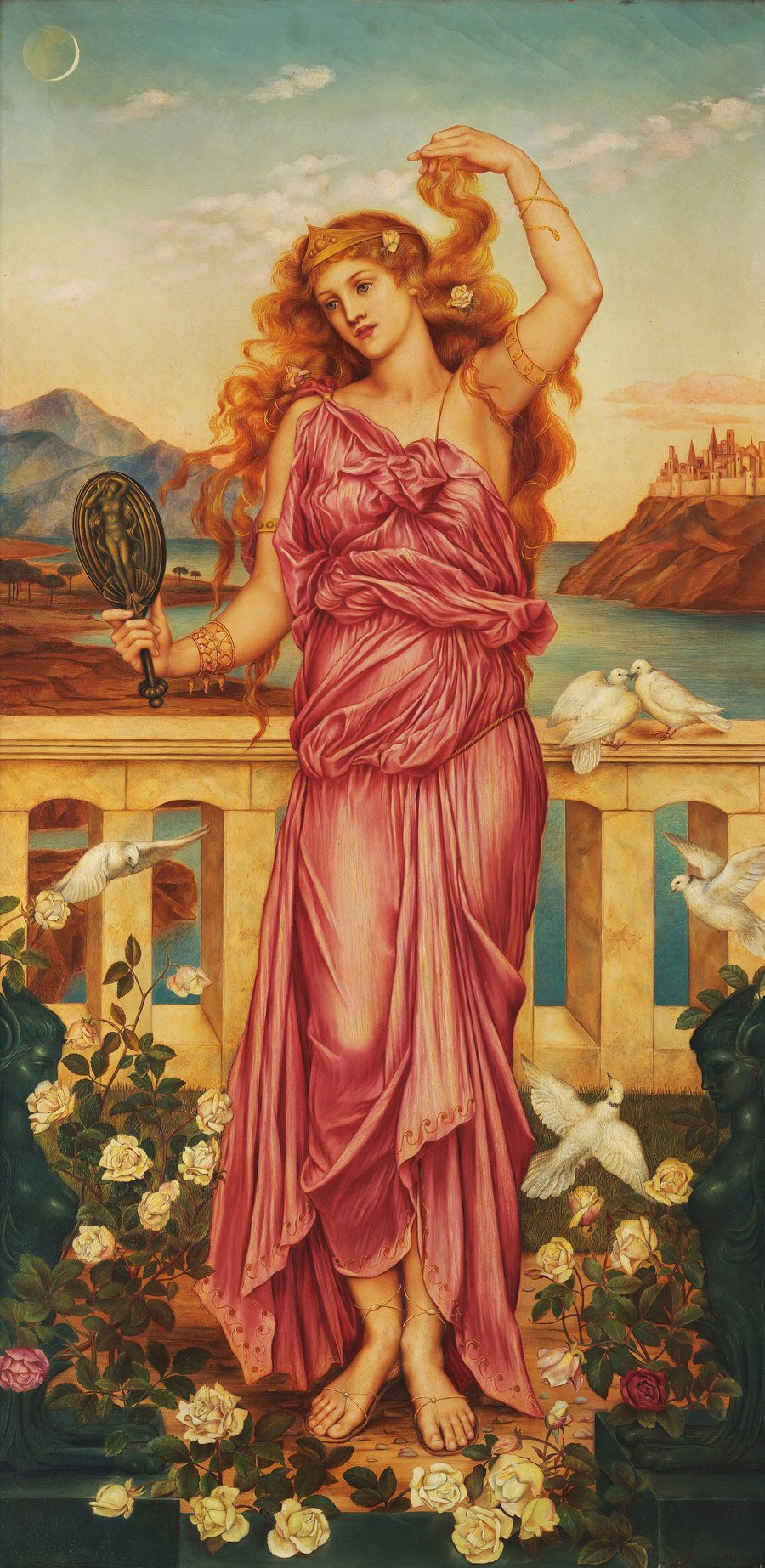 Evelyn De Morgan (1855–1919), Helen of Troy, 1898. Helen stands at ease with a mirror raised to her own face, absorbed in her reflection. De Morgan gives the subject none of the weapons and battles it usually carries, and sets Troy on the hill behind her as what that vanity will cost. Wightwick Manor, Wolverhampton.
One thread does run back into the poem, and it is the asymmetry that Johnathan Bi set against the Golden Rule earlier, pushed further. Xenia is a boundary institution. It presupposes a sharp line between the household and the stranger, and what it asks is not modern moral symmetry but something asymmetrical, owed to the guest because he stands under Zeus’s protection and might be a god. A world in which that line has already dissolved gives the institution no work to do. On Bi’s reading the objection is not to who plays whom but to what the crew implies about the world: if men from across the known earth sit unremarkably among Odysseus’s Ithacans, then the map is already drawn, the contact has already happened, and the sea has stopped being strange. What is lost is mystery, the sense that any figure on any shore might turn out to be a host, a monster, or a god. He says he would have preferred “an all Black/Indian/Chinese cast to what we got”, which is to say that any uniform cast would have served the poem better than a mixed one, because only an unmixed crew leaves the boundary in place.
The argument has a soft spot worth naming. Homer’s boundaries are not racial ones. They run between household and outsider, Greek speaker and barbarian, mortal and god, and his Mediterranean is already busy with Egyptians and Phoenicians, as Odysseus’s own invented Cretan tales attest. Treating visible difference as the marker of Homeric strangeness is itself a modern substitution. What survives the correction is the structural claim, and it is a real one. A world feels large when its outsiders are legible as outsiders, and this is the same unhooking traced earlier, now visible in the casting rather than in the script: an obligation that once ran across a boundary becomes one that presumes no boundary at all.
The dividing line
Here is where it settles. The film does not honour the Odyssey’s themes and it does not miss their point. It switches them, Homer’s tributary for Virgil’s and the ending for Dante’s, so that the cunning, restored king becomes a guilty founder who sails west. That current runs deep enough to surface in the Grey Havens and in Väinämöinen’s copper boat. Its true cost is not fidelity but polyphony, Homer’s refusal of a verdict exchanged for a single legible sentence of inherited guilt.
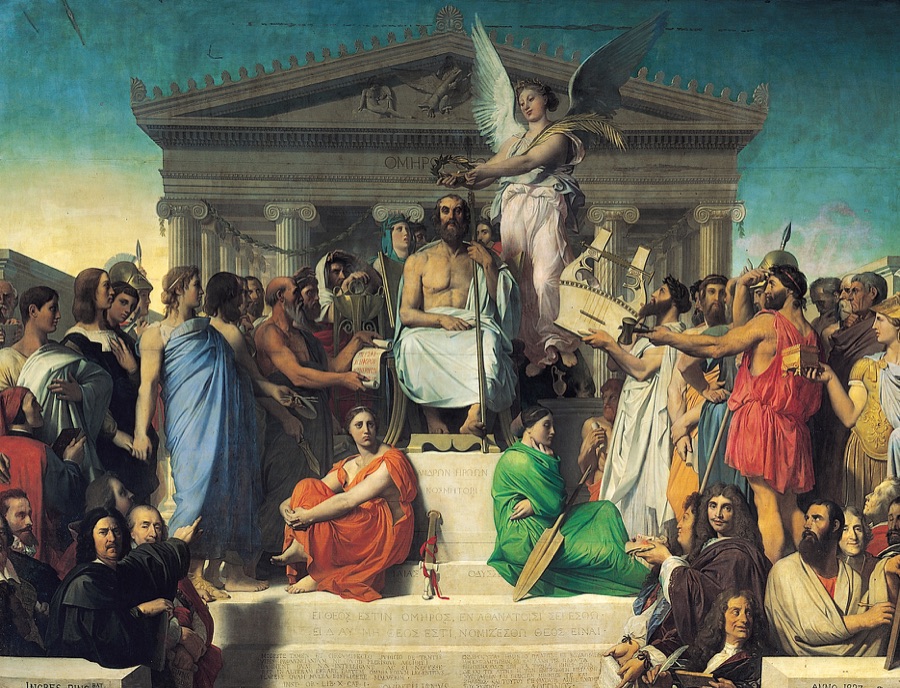 Jean-Auguste-Dominique Ingres (1780–1867), The Apotheosis of Homer, 1827. Homer is crowned before his own temple, with the Iliad in red and the Odyssey in green seated on the steps at his feet, the one holding a sword and the other an oar. Among the moderns at the far left, Virgil leads Dante forward, as in the Comedy. Louvre, Paris.
Whether that is a profound re-contesting or a borrowing of authority to say something close to the poem’s opposite depends on a prior question, and the question is a real one on which reasonable people divide. Are the founding stories of the West a patrimony, to be handed on as intact as possible so that their strangeness keeps its power to challenge us? Or are they common property, which each generation is entitled to fight over and remake? Both answers have a serious tradition behind them, and each carries a cost. The patrimony instinct risks the museum, a reverence that goes lifeless and reduces a living poem to an object under glass. The remaking instinct risks the opposite, taming the foreign so efficiently that it stops challenging anyone, which is what Dvorstone means by gold turned to lead. Neither cost is imaginary, and neither side has a monopoly on the poem.
One thing should be said plainly, because it is usually left out. Neither party to this argument is a lone dissenter, and each argues as though it were. The film arrives with a $250-million budget and a studio behind it, and it has opened to near-universal acclaim. The reaction commanded platforms of its own, enough to leave hundreds of thousands of dislikes on the trailer, to have Universal disable replies, and to make the film a public quarrel months before most people had seen it, and enough to reach a question in the Greek parliament. Which of those counts as power depends on which institutions are being counted, and that disagreement is part of the quarrel rather than a fact standing outside it. What does follow is narrower. The particularist case is not merely nostalgia guarding a museum, and the remaking is not merely vandalism; some of the reaction curdled into ugliness that deserves no defence, and some of the dismissal of it was equally cheap.
This post argues against the grain. The film is a large commercial success and most reviewers have praised it, and in the one round-up of scholarly reaction I have seen, most classicists have embraced it too, though several of them fault Nolan for watering down the poem’s morality. The sharpest dissent has come from Wilson and from commentators outside the academy. Wilson, the harshest of them, still calls the release an event to celebrate, notes that translations are selling, and says she is grateful that Nolan is getting the public reading again.
The film is best understood as what it is, a powerful, coherent, characteristically Nolan work that carries Homer’s name and speaks, for long stretches, in another tradition’s voice, the voice of Virgil and Dante and Milton rather than Homer. That is not ignorance. The switch is a choice, and its price is precisely the polyphony Homer left open. The real dispute The Odyssey has provoked was never the colour of Helen’s skin. It is whether an inherited story is ours to keep or ours to remake, and who the “ours” in that sentence turns out to be. On that question, and not on the casting, the film should be judged.